Palaeo-diets aside, the
food we eat today is not the same as our ancestors. Scientists, GMO’s
(Genetically Modified Organisms) supermarkets and corporations now significantly control the
food chain. Changes made to food by big business have led to big changes in people's health. For example, millions of Americans now
suffer Celiac disease, food allergies and related autoimmune problems. Some
people think GMO and modern wheat is slowly killing us.
I think it’s a natural law
of the earth that what supports life--lasts, and what doesn’t support
life--eventually fails. In their own ways, some people are taking back control
of the food they eat.
Raising chickens in backyards.
Planting fruit trees and
vegetable gardens.
Permaculture gardening.
Organic gardening.
Community gardens.
Roof gardens.
Balcony potted plants.
Footpath gardens which
might include food crops that are shared among resident in the streets.
Collecting rain water.
Last week I wrote about
“Lizard Brain”, the primeval thinking part of the brain that looks out for our
survival. Yes, food and water are necessary to sustain the body. But food can
mean a whole more. Food is a creature comfort that can change our mood and give
us a sense of well-being. Food is one of the simple pleasures in life.
Feeling good!
Coming up on my Google + site, I’m going to have a foodie week. I’ll post articles about two new ideas
for coffee. Waking up to a hot coffee by your bedside. Have you heard about
deconstructed coffee? It’s news to me, but in Melbourne it’s a hipster trend.
I’ll have some recipes to
whip up in the kitchen. Both of my kids love watching The Great British
Bake-off on television. I’m not sure why, and so far the baking show far hasn’t
led to any spontaneous rising from the sofa and heading to the kitchen to cook
something. Just lots of ‘I’m hungry’ vocals and ‘I like that’ comments. Earlier
this year, the kids called me to watch an episode about cooking stained glass
biscuits. I was captivated by the idea of a biscuit with a hollow shaped center
that’s filled with a hard-boiled lolly to give a stained glass window effect. I
found a recipe to try.
Finally, did you know the
mature cheese on top of your pasta meal, might not be any old cheese. There’s
an Italian cheese bank where cheese is valued like gold and stored in a
refrigerated bank vault. I hope you can join me again on G+. Before I go, there have
been some wonderful Solstice sunrises in the outback. I took some photographs
on Monday and Wednesday morning.
Monday 20 June 2016
Wednesday 22 June 2016
Very bright sun rising, Wednesday 22 June 2016
Over the weekend,
enjoy your tucker (an Australian bush word for
food)
I wish I could chill out but it seems I can only write about
the idea. I’m running on the treadmill of a busy life and can’t stop.
Were we born to live a harried life?
Squeeze in as many chores and jobs as possible during the waking hours.
If I don’t keep running what will happen? Will some part of my
life fall apart and there’ll be consequences? Shudder!
I’ve learnt a thing or two about the beast called ‘stress’
during my years of sprinting and running marathons on the hamster wheel.
The body is not just a machine ruled by the clock.
It’s an organic, hunk of flesh and bones made from the
minerals and waters of the earth. The body is designed for trekking over the land, doing work to ensure survival, and for
pleasure andplay. Feeling good is important to the body, it lifts the spirit, de-stresses
the mind, vitalizes the immune system, lowers blood pressure, helps balance
hormones, and eases the overload of adrenalin charging through the veins.
Pleasure from creature comforts is a primal way to feel good.
Towards the bottom of the brain stem, we still have an ancient, primitive clump
of grey matter. Australian romance writer, Nikki Logan, calls this part of the
brain, the‘lizard brain’. In the very least, the lizard brain is the caretaker of
our physical survival. The signal center where danger and threats are registered,
and where the ‘flight or fight’ response is triggered. Nikki has written a book
about the chemistry of reading and our reptilian selves. She gives clues on how to produce books
that engage and excite readers. If you'd like to find out more, here's the link to Nikki's site,http://nikkilogan.com.au/books/how-to/the-chemistry-of-reading/
So this old lizard brain part of ourselves is still on duty,
checking that we are keeping the body safe, have clothes and shelter from the
weather, getting enough sleep, drinking clean water and eating fresh food.
Satisfying the primal self leads to a sense of well-being, and then we can engage
in the more sophisticated parts of our lives.
This week on Google +, I’ll be featuring articles about chilling
out, creature comforts and feeling good. I hope you can join me again.
Collateral, down payments, and variable or fixed term
interest rates.
Cities are expensive places to live.
New this century is the 30 year home mortgage?
Don’t wait until you’re old to apply for your first home loan
or you might not clear the debt before the pearly gates swing open to let you
in.
Small houses are not a new idea.
From the local history books, the gold rushes of the late 18th
and early 19th century transformed a struggling British colony into the State of
Western Australia. Men came from all over the world to search for gold and find
their fortunes.
Pioneers panning for gold.
The pioneers started by camping out under the stars, made
bush shelters out of trees and mud, next came the hessian tents, and then the
one-roomed houses made of corrugated tin. Eventually timber weather-board homes
were built. More expensive, red brick, multi-room homes were constructed for
the wealthier people. It’s interesting that at the turn of the 19th
century, bathrooms, toilets and laundries were not part of the main house. They
were outbuildings in the backyard. Not good for the middle of the night visits,
winter or rainy weather.
Gum trees and acacia scrub in my local area.
The most interesting pioneer house I’ve seen was made of food
and tobacco cans. The old-timers had to carry their own food and water
provisions as well as their prospecting equipment-picks, shovels and pans.
Fresh water was rare, and there were few white people or towns in the semi-arid
inland areas of Western Australia.
Salted beef (bully beef) was a popular tin food back then.
Men also smoked tobacco in their pipes. The owner of the house, had flattened food and tobacco cans into small metal strips he nailed together to
use as exterior cladding on his home. He was possibly a poor man or down on his
luck. The pioneer times were tough and people died from thirst, starvation and
disease. This home-maker recycled what he had. He was innovative, he labored,
had patience, and he bettered his circumstances. His house made of tin cans is
oddly beautiful.
Me driving down an eroded bush track.
A couple of years ago, I had to make a call on a guy
who lived a hermit-like existence in the bush. His bed and cooking facilities
were located in a small caravan. He needed more space for gym equipment (to
improve his failing health) and to set-up a computer with an internet
connection.
So he dug himself a hole in the ground. Then he covered it
with sheets of tins and pinned down the metal roof with loose tree branches. He
set up a trailer with solar panels and batteries for his electrics.
He cut neat steps down through the red clay rock to his
underground room. A plastic shower curtain hung as a door. The dug-out blended
in with the surrounding woodland. I walked all over his camp site trying to
find him. He eventually heard me calling his name and came to the surface. He
boiled some water in a saucepan on his caravan stove to make a cup of tea. I
sat down outside on a milk crate to talk to him. I was tempted to stir my tea in an enamel cup with a gum leaf for authentic bush flavor.
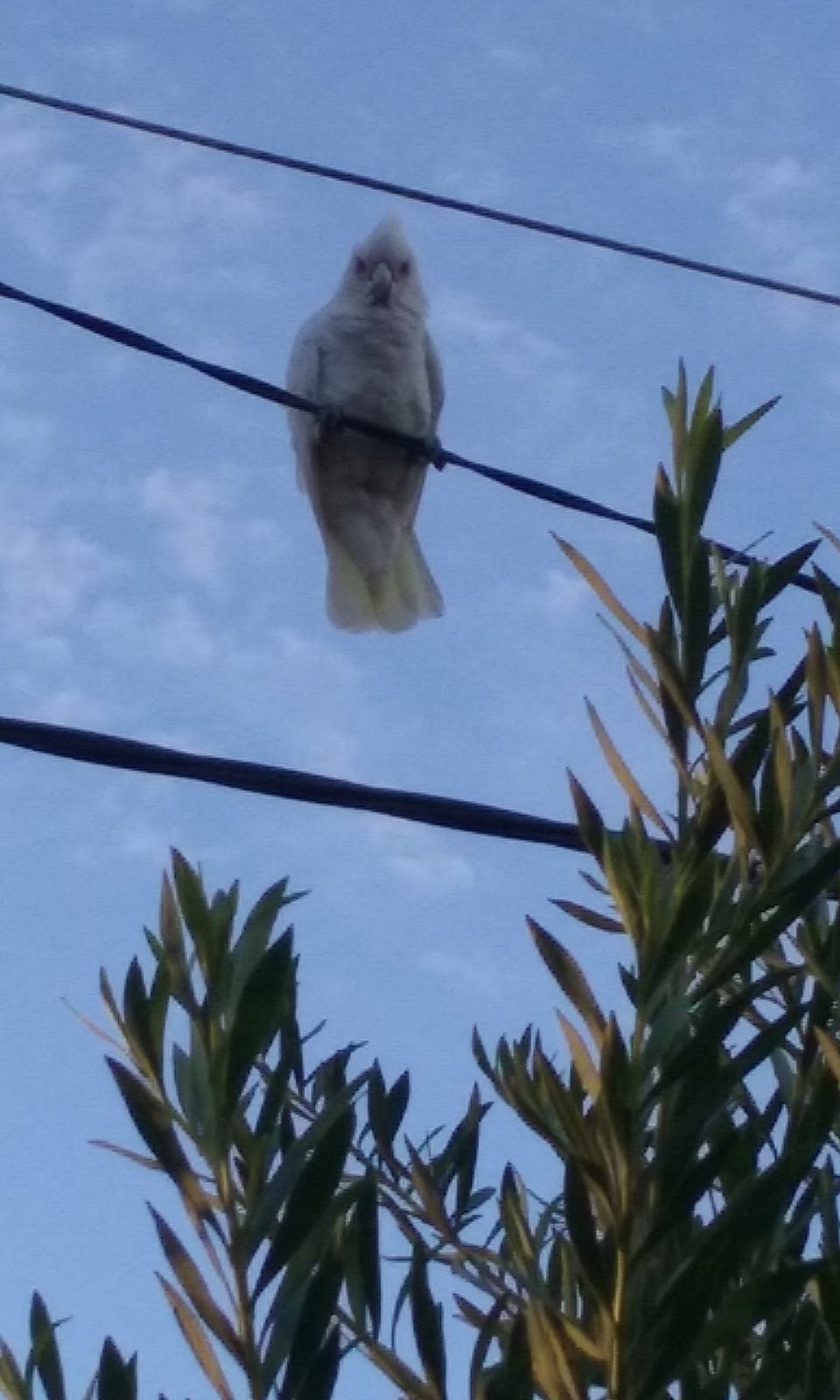
Cockatoo sitting on the electrical wires at the front of my house.
Old ways won’t open new doors.
All over the world there is a small housing revolution
underway.
It starts with a life-style choice and means downsizing space.
Gypsy caravans and grey nomads, people are thinking different
ideas about owning their own homes.
Paying off smaller home mortgages and being able to afford to
live.
Sustainable homes.
Salvaged homes.
Recycling.
Self-contained and off-grid.
A dream home worth pursuing for some people.
This week on Google + I’ll be featuring articles about Small
Houses. Homes on wheels, a barn conversion, a home that turns in a circle to
catch the sun, holiday cabins, and cardboard homes.
Hello and welcome to this
week’s blog about the Celts. I had planned on writing a blog about Celtic Women,
but I got side-tracked with writing history, and the word count kept growing
longer and longer. I had to find a place to stop or I’d been writing a book.
The Ancient Celts
The Celts had an oral
tradition of passing on their history and stories. So what is written about
them are the words of others. Current thinking is that the Celts were not one single race of people, but rather tribes of people who shared common languages,
religions and some cultural traditions.
Around the 6th
Century BC, the core of Celtic people lived in central Europe, in the area of
Austria. Over the centuries that followed, they migrated to eastern and western
Europe, France, Portugal, Spanish Galicia, Italy and the British Isles.
The Romans and the Celts
World domination versus the Barbarians.
History suggests the Celts
were a pain in the butt to Roman leadership, until the Celts were conquered, or surrendered and were subjugated, or retreated to lands that are still Celtic
strongholds today.
In the 4th
Century BC, tribes of Celts (Gauls) had migrated to Northern Italy to settle and
farm the lands. They developed an obsessive taste for Italian wine. Relations with
the early Roman neighbors turned sour, and tensions escalated.
The Gauls attacked Rome,
which was already a prosperous city. The people who could escape the march of
the terrifying barbarians fled to the countryside. The Vestal Virgins and
religious treasures were carted away to a secret location.
The Gauls were tall, with
long, fair hair. They wore plaid-patterned clothes. Gold torques encircled
their necks. They went into battle naked to the waist and with their magical
tattoos on display. The warriors fought as individuals, in their own style with
their own weapons as part of a clan.
The siege at Capitoline
Hill went on for months and Rome was subjected to the usual horrors and savagery
of war. Finally the Romans offered 1000 pounds of gold to end the battle. The
Gauls accepted the booty and withdrew from Rome.
Bad blood was split on
Roman soil and it would last for centuries to come....including Julius Caesar's Gallic Wars (in France and Belgium) and the conquest of Britain.
Massacre of the Druids
By 50 A.D most of southern
England had fallen to Roman occupation. The native Brits (including the Celtic tribes)
staged guerrilla attacks to resist Roman rule. Finally in 57 A.D, the Roman General Suetonius reached his limit of endurance. He led his armies west and
then north into Wales to reach the sacred home of the Druids—the island of
Anglesey.
The Druids were the
spiritual leaders in Celtic society. They were made up of women and men. They
had power and influence over the hearts and minds of the people. Kill the
Druids and you kill the people’s leaders. The conquest of Britain is more likely.
Between the Welsh mainland
and Anglesey lay a treacherous, sandy strait of water subject to cross-currents
and undertow. The Romans felled trees and built boats made of green timber to cross the strait.
Waiting on the island's shores, were the Druids and their company. The
final battle was imminent. Wild-haired women brandished torches. Druids
shouted invocations to the deities.
At first the Romans feared
the crazed enemy, then they launched their blood-thirsty attack. The men, women
and children were massacred on the beach and then the island was ransacked.
That was the end of the
Druids and the British tradition of natural magic. Over the centuries that followed, secret societies came into
being but eighteen hundred years would pass before there was widespread
interest in Druidism again. A revival took place In the Victorian Age.
Hadrian’s Wall
I’m veering from the
Celtic path for a bit to visit Hadrian’s Wall which was also called the Roman
Wall. It was built coast to coast across northern Britain at a time when the
Roman Empire had stopped expanding and was consolidating.
The fortress wall was
started in 122 A.D and took 6 years to complete. It was probably built for many reasons
including taxation, control of migration, and to stop the cattle-raiders and
smugglers. The purpose was also to keep out the Barbarians to the north which
included the Scottish tribes. Rebellion to Roman rule hadn’t stopped.
♥ ♥ ♥ ♥
Coming up on Google + next
week, I’ll be posting articles about Celtic Women, the fourth topic in my
series of Interesting Women posts. I’ll be featuring the Tuatha de Denann, a
supernatural tribe in Irish Mythology. They were also known as the “people of the
Goddess Danu” (name associated with the Danube River).
source: www.pinterest.com
I have to include Boadicea,
Queen of the Celtic Iceni tribe.
“We British are used to women commanders in war; I am
descended from mighty men! But I am not fighting for my kingdom and wealth now.
I am fighting as an ordinary person for my lost freedom, my bruised body, and
my outraged daughters.... Consider how many of you are fighting — and why! Then
you will win this battle, or perish. That is what I, a woman, plan to do!— let
the men live in slavery if they will.”
These are the words of
Queen Boadicea, according to ancient historian Tacitus, as she summoned her
people to unleash war upon the Romans.
Boadicea fought the Roman
occupation of Britain. She set fire to
Londinium (London), and massacred the people. She was eventually defeated but
was never captured by the Romans.
source: www.pinterest.com
Morrigan was, and, is the great
triple Goddess (maiden, mother and crone) of Ireland. She has many associations, with crows, life and death, and being a warrior.
Morrigan had a relationship of some sort with Dagda, the High King and great God of the Tuatha de Denann people.
And one day, in the distant future, I would like to write a fictional story about the encounters between Morrigan and Dagda set during the time of the Roman occupation
of Britain.
If you can, please come
and read about the Celtic Women next week. Thank you for reading this lengthy
blog.
Stonehenge - from the mists of time and
still standing.
The experts are still piecing together the mystery of Stonehenge. Why
was it built? How did the ancients
transport the “Sarsen” bluestones from a quarry in Wales located over 100 miles
away. What is Stonehenge's purpose?
A cremation cemetery?
Despite artists portraying prehistoric man as in charge of the site, in
the latest discovery, half of the prehistoric, cremated bones belong to women. Could women have been as noteworthy as men in
prehistoric Britain?
A Pirate Story
A lot of people like a good pirate story and perhaps a costume for
Halloween. Remember, Peter Pan, Captain Hook and the alligator. The stage
musical, “Pirates of Penzance”. The “Pirates of the Caribbean” movie franchise. There’s
too many pirate movies, music, stage and television shows, games and comics in
popular entertainment to name here.
Less well-known are the 5 notorious female pirates from the 18th Century.
Once there was a superstitious belief among pirates that having women aboard a
ship was bad luck. Meeting Anne Bonny and Mary Read on the high seas would
knock the wind out of anybody's sails. In 1720, Anne and Mary teamed up. The two marauders
were the most feared female pirates to raid fishing boats and trading sloops.
China 1801, Cheng I Sao, with her husband raised a pirate army of 50,000
men. After her husband’s death in 1807, she continued her plundering ways until
the British and Portuguese forced her retirement. She ran a gambling house
until her death. Cheng I Sao was one of history’s most successful pirates.
More Mutiny
In 1938, Australian actress, Mary Maguire was kicked out of Hollywood
for her mutiny against the role of ingénue (innocent and wholesome women). She wanted a dramatic part in a movie.
Lady Worsley, contemporary of Jane
Austen
Seymour, Lady Worsley, was at the center of one of the Georgian era’s
biggest scandals. The Lady was a contemporary of Jane Austen and also her neighbor.
Lady Worsley was an heiress and a high-spirited woman who was the
property of her husband. Her monetary worth was attributed to her virtue. If
she was proved to be less than virtuous, her worth decreased. She lost her
virtue and her husband went to court to sue for compensation. There’s more about
Seymour’s character in the video below from the BBC drama production.
Well that’s some of the highlights from next week’s G+ posts. I hope you
can join me again.
The character of the Warrior
Woman is back in main-stream entertainment with the women from Games of
Thrones, Katniss from The Hunger Games, Wonder Woman and Xena, Warrior
Princess.
The Xena reboot is expected
later in the year, but without actresses, Lucy Lawless and Renee O’Connor
playing the roles of Xena and her best friend, Gabrielle. The replacement
of the actresses is a sensitive topic with fans. Other shows, like the X-Files
and the movie, Star Wars have brought back their original stars.
Xena has her origins in Greek mythology. In the beginning of the television show, Xena was
a villain, who was intent on killing the god, Hercules. Over the length of the series, she endures a painful path to redemption, and makes the ultimate sacrifice for the 40,000
lives she took in battle.
The Amazons are the
legendary warrior women from the history books. Did they really exist?
“Archaeology shows that these fierce women also
smoked pot, got tattoos, killed—and loved—men.”
Adrienne Mayor from the
Princeton University Press has written a book, “The Amazons: Lives and Legends
of Warrior Women across the Ancient World.”
From Adrienne, “The real Amazons were long believed to be
purely imaginary. They were the mythical warrior women who were the archenemies
of the ancient Greeks. Every Greek hero or champion, from Hercules to Theseus
and Achilles, had to prove his mettle by fighting a powerful warrior queen.”
With Mother’s Day just passed, I thought I would
write about what some interesting women are doing in the world. There are women
who didn’t accept the ‘norm’ or the ‘status quo’. Disrupters! Women, who
rallied their ideas to improve their circumstances.
Some of the women ignored social stereotypes and
got on with their work. Perhaps the women were finding solutions to
problems they faced. Others might have been striving for their well-being or
even struggling to survive. Some of the women forged ahead as individuals while
others worked in teams.
This coming week on Google +, I’ll be posting
articles about an Italian Winery run by women. The ordinary woman who walked
around the world. A fashion icon. A make-up impresario. The jewelry making by
the women of Rwanda which provides clean water, education and food. A shoe
entrepreneur who fits small feet, narrow feet, wide feet, big feet and odd
feet. And finally, there’s an article about a woman who wants to retell history
by including women’s contributions.
As Robin Williams once said, “words and ideas can
change the world”.
Be inspired…
♥ LOVE
choose your path in life,
create a satisfying life,
live passionately,
experience life with greater awareness,
do something different,
make a change,
help others,
and achieve your own happiness. I hope you can join me on Google +. Enjoy your weekend. ♥ Ashlyn
Mother’s Day is coming this
Sunday. It’s time to think about our Mums and what they mean in our lives.
I’ve searched the
internet looking for touching tributes to mothers. The sickly sweet, all-sacrificing Mum who is a fountain of ever-renewing love is not a woman I can
relate to. I’ve had my bad days of being a mother.
And there’s the Mother’s
Day version of Katie Perry’s “ROAR” song.
I got through a bout of
post-natal depression. The rip-my-hair-out moments don’t stop. I’ve checked the
self-doubts— why the hell did I ever have children? The hurt from the knife stabbed
into the heart— was me being much too sensitive about my brood spreading their
wings and testing their independence.
Hello Mom, are you still
there? Here’s a Mummy singing Adele’s “HELLO” song.
♥ ♥ ♥
♥
Then I remember the kids as
newborn babies. How I feel in love with each one of them in a way that was too
profound to find the words to describe. No matter what life throws in our
paths, the kid’s special place in my heart won’t change. Now I understand, the
worry and anxiety I put my own mother through as I grew up and I grow old.
Education, health and
happiness is what I want the most for my children. I tell them, follow your
dreams. Use your manners. Be kind to others and look out for animals. The
household fairy has forgotten to wave her magic wand to wash the dirty dishes.
Can you help out? Please.
Back in maybe, 2007, mother and comedian, Anita Renfroe, condensed what a mother would say to her children in
a 24hr period into 2 mins 55 seconds. Here is the video of Anita’s famous “MOM”
song to the music of the “William Tell Overture”.
The kids have stopped listening to my
nagging and do what they’ve always done—learn by example. The ways of a mother
in the home, among family and friends, and in the world at large is where
children observe and absorb information.
Mothers don’t have to be perfect
people nor do they have to fit the stereotypes created by others. Mothers are individuals
and diverse people the world over. LOVE is the answer to everything.
Next
weekend, it will be Mother’s Day in Australia and also in many other parts of
the world. For all the children, I wish
they had enough food, water, shelter, clothing, education and love in their
lives. Yet many children live in suffering each day. Why?
As
a mother-of-two, if I could change the current state of the nations, the top 4 items on my fix-it list would be;
1.An end to War, and peace on Earth.
2.The world becomes a humane and
habitable place to live for all.
3.Restore the health and vitality of
the environment.
4.LOVE.
I
recently shared this picture post from +dalajlamapeace on G+.
Disruption,
is the buzzword, disruption brings new thinking to old problems or ways of
doing things. The divide between the rich and poor isn’t shrinking, it’s
growing. Most of the world’s wealth is owned by 1% of the population.
Next
week, as the days countdown to Mother’s Day, I will posting about Disruption
on G+. I am very pleased to write about the positive initiatives taking
place in the world. I’ve found articles about an entrepreneur who wants to end
hunger in America. A French law that forbids food waste. Female food heroes in
Tanzania. The best supermarket in the world. Once Australian schoolchildren
were given free milk. How to survive kids and grey hairs.
Let's celebrate
the hope,
and the
positive action.
Feel
the progressives vibes,
from
one initiative to another,
ripple out across the land and seas.
Friends,
the world is slowly changing for the better.